

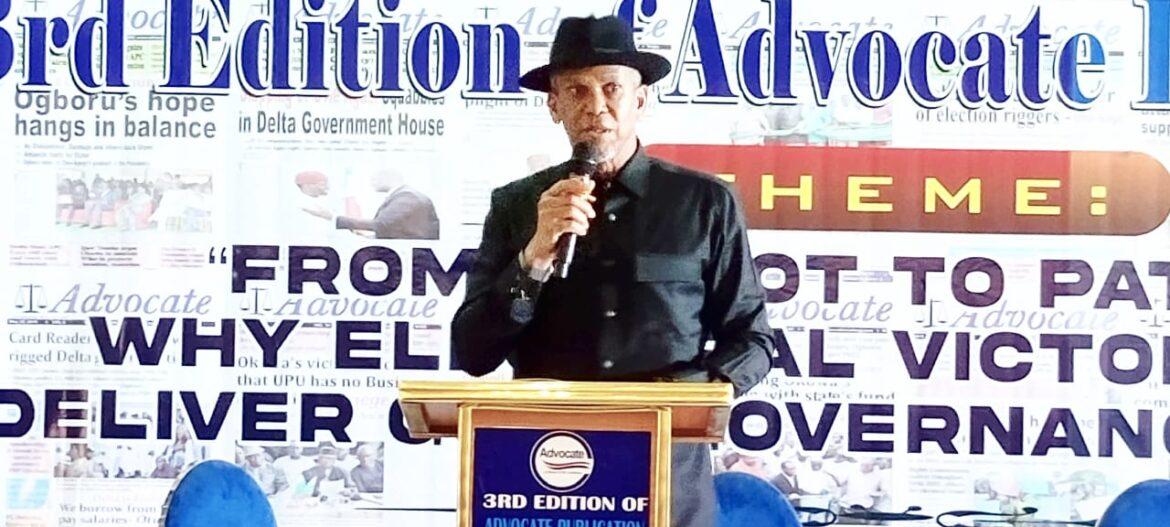
Delta Central Senator, Ede Dafinone, has called for a decisive shift from rhetoric to practical solutions in addressing Nigeria’s governance challenges, warning that electoral victories must translate into tangible benefits for citizens.
Dafinone made the call at the 3rd Advocate Lecture Series organised by Advocate Publication Ltd, publishers of Advocate Newspaper. The lecture, themed, “From Ballot to Patronage: Why Electoral Victory Fails to Deliver Good Governance in Nigeria,” drew stakeholders from across the political and civic space.

“I am always glad when conversations like this move beyond identifying problems to offering real solutions.
“It is easy to talk about what is wrong, but far more important to focus on how we can fix it,” Dafinone said.
Addressing concerns about a possible one-party dominance, the senator noted that defections to ruling parties are not a new phenomenon. “As we approach the 2027 elections, many Nigerians are expressing concerns about a possible one-party state. However, this is a common mid-term political trend we have seen since 1999,” he explained.
Reflecting on Nigeria’s electoral history, Dafinone observed that while the process has improved, significant challenges persist. “In 2023, Nigerians were more aware and votes were more credible. However, we still face the problem of vote-buying, which reflects a deeper issue, many Nigerians feel their votes do not count,” he said.
He also defended recent economic reforms, including the removal of fuel subsidies, noting that such measures, though painful, were necessary. “Previous leaders avoided these decisions to remain popular, but the current administration chose the hard path. I want to assure Nigerians that the benefits will come,” he added.
In his keynote address, Charles Apoki delivered a blunt assessment of Nigeria’s democratic system, arguing that citizens have lost ownership of governance. “That is not democracy. Democracy is government of the people, by the people, and for the people. But in Nigeria today, the people do not own the government,” he said.
Apoki attributed this disconnect to widespread political ignorance and the commodification of votes. “Nigerians sell their rights for small amounts of money, and politicians turn personal interests into public concerns,” he noted, adding that many aspiring leaders lack concrete development plans.
He further criticised the high cost of politics, describing it as a major barrier to credible leadership. “Politics in Nigeria is too expensive. Those who win often focus on recovering their expenses rather than serving the people, leading to a system dominated by godfathers,” he said.
Earlier, the Chief Executive Officer of Advocate Publication Ltd, Shedrack Onitsha, explained that the theme was chosen to address the persistent disconnect between electoral success and governance outcomes. “Over the years, we have discovered that elections do not translate to good governance. Governments come with promises, but at the end, there is little to show,” he said.
The event, held at Wetland Hotel, featured panel discussions and goodwill messages from dignitaries, including Sheriff Oborevwori, who was represented, alongside other stakeholders. Participants collectively called for reforms aimed at strengthening institutions and ensuring that democracy delivers real dividends to Nigerians.