
President Bola Ahmed Tinubu has assured Nigerians that his administration’s ongoing reforms in the nation’s security architecture and economy are beginning to yield positive results, expressing confidence that terrorism, banditry and kidnapping would soon be decisively defeated.
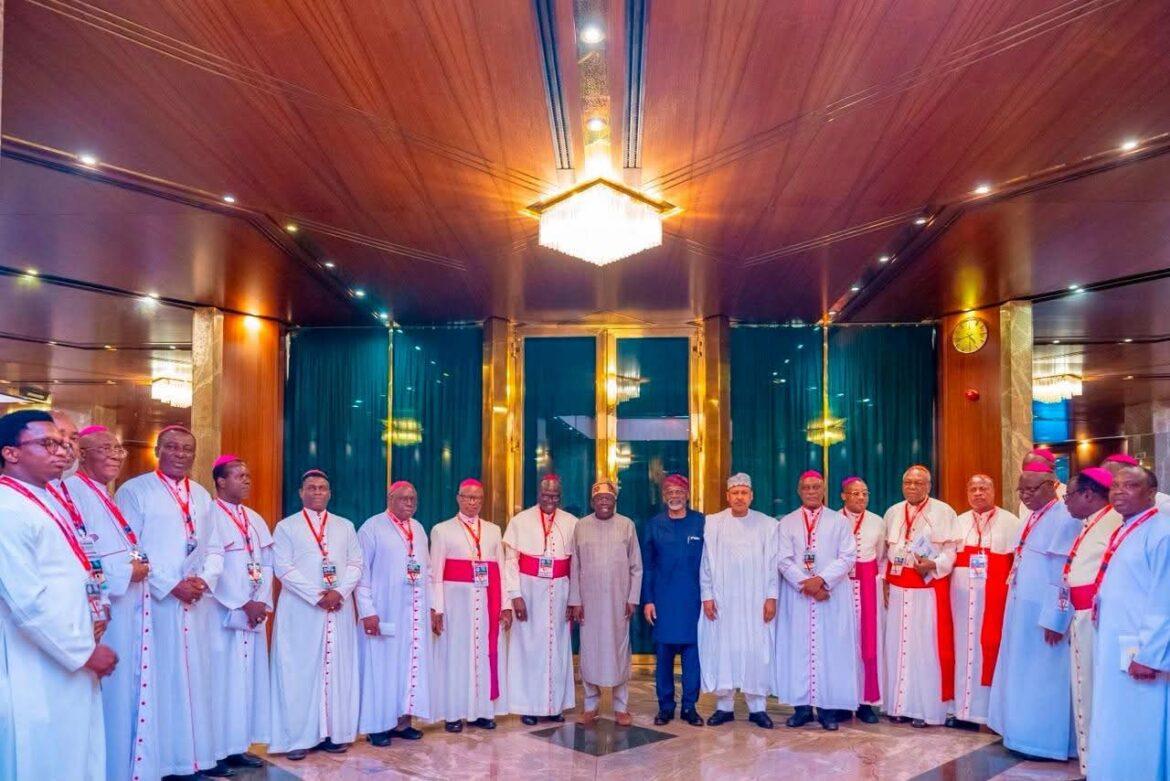
The President gave the assurance on Tuesday at the State House, Abuja, while receiving the leadership of the Catholic Bishops’ Conference of Nigeria (CBCN), led by its President, Most Rev. Matthew Ndagoso, Archbishop of Kaduna, who visited him alongside 19 senior Catholic bishops.
President Tinubu said his administration had embarked on a comprehensive restructuring and repositioning of the country’s security institutions to make them more efficient and effective in tackling insecurity.
According to him, the Federal Government is strengthening intelligence gathering, improving logistics, enhancing the welfare of frontline security personnel and expanding the nation’s military capacity to ensure lasting peace across the country.
“I have just approved the expansion of the armed forces. We are acquiring more equipment, building new barracks, and we will defeat terrorism,” the President declared, urging religious leaders to continue preaching peace and actively support government efforts to end insurgency and violent crimes.
He stressed that every Nigerian had a collective responsibility to protect the unity and stability of the country, describing Nigeria as the only homeland shared by all its citizens.
On the economy, President Tinubu said the difficult but necessary reforms initiated by his administration had successfully rescued the country from economic collapse and placed it on the path of sustainable growth and prosperity.
“The economy has recovered. The alarm for bankruptcy and the dark tunnel of uncertainty that confronted us when I assumed office have been overcome. This government has stabilised the nation, and prosperity is on the horizon. Life is improving,” he said.
The President explained that his administration inherited enormous economic challenges but remained committed to implementing bold reforms capable of laying a solid foundation for long-term national development.
He reaffirmed the government’s commitment to poverty reduction through strategic intervention programmes, particularly the Nigerian Education Loan Fund (NELFUND), which he described as a major investment in the future of Nigerian youths.
President Tinubu urged Nigerians, especially young people, to take advantage of the numerous opportunities being created through education, entrepreneurship and skills acquisition programmes to improve their lives and contribute meaningfully to national development.
Speaking on the education sector, the President noted with satisfaction that academic activities in public universities had become more stable, pointing out that prolonged strikes by the Academic Staff Union of Universities (ASUU) had become a thing of the past.
“You can’t say a four-year university programme is no longer completed in four years. ASUU is not on strike, and families are no longer subjected to that agony. That, for me, is an answered prayer,” he stated.
On the 2027 general elections, President Tinubu maintained that the Independent National Electoral Commission (INEC) remained impartial and had provided a level playing field for all political parties.
He dismissed allegations of intimidation by opposition elements, insisting that the electoral umpire had conducted itself fairly and independently.
The President also reiterated his support for quality education, revealing that more universities had been approved to expand access to higher education, while noting that data from the National Universities Commission (NUC) would assist in the effective planning and funding of NELFUND.
Addressing the request for the return of mission schools, President Tinubu recalled that as Governor of Lagos State, he approved the return of mission schools to their original owners, adding that under Nigeria’s constitutional arrangement, state governors possess the authority to take similar decisions within their respective states.
Earlier, the President of the Catholic Bishops’ Conference of Nigeria, Most Rev. Matthew Ndagoso, commended President Tinubu for the warm reception accorded the Holy See’s Secretary for Relations with States and International Organisations, Archbishop Paul Gallagher, during the recent celebration marking 50 years of diplomatic relations between Nigeria and the Vatican.
Archbishop Ndagoso also drew the President’s attention to critical national concerns, including insecurity, access to quality tertiary education, poverty, the strengthening of democratic institutions and the need to guarantee free, fair and credible elections in 2027.
He appealed to the Federal Government to encourage the return of mission schools where appropriate and ensure equal treatment for all religious groups, including the provision of worship facilities without discrimination.
The Archbishop further urged President Tinubu to consolidate Nigeria’s democratic gains, noting that his enduring legacy would be the strengthening of democratic institutions, having played a significant role in the country’s struggle for the restoration of democratic governance.
The meeting was attended by prominent members of the Catholic Bishops’ Conference of Nigeria, including Archbishop Emeritus of Abuja, John Cardinal Onaiyekan; Bishop of Ekwulobia, Peter Cardinal Okpaleke; Archbishop of Abuja, Most Rev. Ignatius Kaigama; Archbishop of Lagos, Most Rev. Alfred Martins; Bishop of Sokoto, Most Rev. Matthew Kukah, alongside several other archbishops, bishops and senior Catholic clergy.